Paris, France

Paris

France · 3 free tours

4.7 average · 97,603 reviews

Paris was designed to be walked — Haussmann’s boulevards, the Seine’s bridges and neighborhoods that still behave like separate villages. A free tour turns postcard views into stories: revolutions plotted in cafés, artists starving gloriously in Montmartre, kings losing their heads a short stroll from where you’ll stand.

Start with the historic heart around Notre-Dame and the Latin Quarter, then climb Montmartre for the bohemian legend, or explore Le Marais’ aristocratic mansions and falafel-scented lanes.

Free walking tours in Paris

Plan your visit to Paris

Top things to do in Paris

Paris rewards walkers along the Seine. See the Eiffel Tower from the Trocadéro, the reborn Notre-Dame on the Île de la Cité, and the Louvre's glass pyramid, then stroll the Champs-Élysées to the Arc de Triomphe.

Climb Montmartre to Sacré-Cœur for the city at your feet, browse the bouquinistes' book stalls, and give yourself a slow afternoon in a café — in Paris, watching the street go by is a legitimate activity.

Neighborhoods and where to eat

The Marais is aristocratic mansions, falafel and vintage shops; Saint-Germain-des-Prés is literary café culture, Montmartre is bohemian, and Canal Saint-Martin is where young Paris picnics.

Eat a real croissant and baguette, steak-frites, and cheese from a fromagerie, and treat a bistro dinner as an event, not a refuel. Covered passages and street markets are the tastiest way to browse.

Getting around and best time to visit

The metro reaches everywhere and central Paris is smaller than it looks — most icons are a 30-minute walk apart. A Navigo Easy card or carnet of tickets covers metro, bus and tram; RER trains link both airports.

Spring (April–June) and September–October are the classic sweet spots: mild and photogenic. Summer is warm but many locals leave in August; winter is quiet, atmospheric and made for museums and cafés.

Is a free walking tour in Paris worth it?

Paris is too big for one walk, and accepting that is what keeps the experience from disappointing. A free tour does not show you the city; it shows you one well told slice of it, usually the Île de la Cité and the Latin Quarter, or Montmartre, or the Marais. What you gain is the thread connecting those buildings, which in Paris is almost always a story of revolutions, fires and rebuilds.

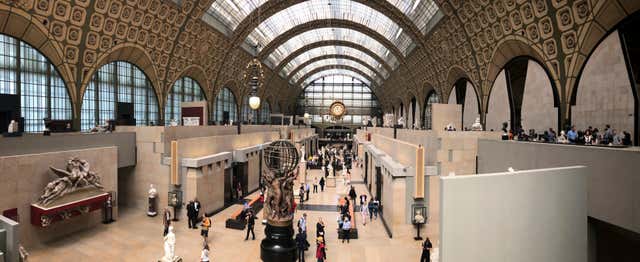
Museums are not included. The Louvre, the Orsay and the Eiffel Tower summit are ticketed with timed entry, and Notre-Dame, reopened in December 2024, is free to enter but comes with long queues and slot reservations best organised separately. A guide will explain it from the square in front.

How booking and tipping work in Paris

Booking costs nothing and the confirmation carries the meeting point, which changes by route: the classic walk starts at Hôtel de Ville metro, the Montmartre route at metro Blanche by the Moulin Rouge, and the mysteries route at the Saint-Michel fountain. Groups are capped, so book a couple of days ahead in spring and summer.

You choose the amount at the end. Ten to twenty euros per person is the Paris norm, in cash and in small notes. Nothing is charged upfront, and if plans change, cancel from your confirmation email rather than simply not turning up.

Good to know before you go

  • The metro is great, but central Paris is smaller than it looks — most icons are 30 minutes apart on foot.
  • Café terrace prices vary by neighborhood, not quality; your guide knows the fair ones.
  • Montmartre tours involve stairs. Many, many stairs. The view earns them.
  • The bracelet scam on the Sacré-Cœur steps and the found ring scam near the Eiffel Tower both open with someone reaching for your hand. Keep walking with the group and do not stop to look.
  • The metro beats any taxi for reaching a meeting point, but many central stations are stairs only. Add ten minutes if you are arriving with luggage or a pushchair.
Beyond the free tours

Make the most of Paris

Paid experiences from our partner Viator — day trips, cruises and skip-the-line activities that pair well with a free tour.

Rest those walking legs

Where to stay in Paris

Well-reviewed stays from our partner Agoda. Prices are indicative for a double room, loaded live — your dates may vary.

Frequently asked questions

Are free walking tours in Paris really free?

Yes. There is no ticket and no upfront cost — you reserve a spot, show up and enjoy the tour. At the end you tip your guide whatever you feel the experience was worth. Most travelers tip the equivalent of €10–20 per person, but it is entirely up to you.

Where do free tours in Paris usually start?

Meeting points vary by route: the classic tour meets at the Hôtel de Ville metro stop, the Montmartre tour at metro Blanche by the Moulin Rouge, and the Mysteries tour at the Saint-Michel fountain. The exact point is always confirmed on each tour page and in your booking confirmation.

Do I need to book in advance?

Booking is free and strongly recommended — groups are capped so tours stay personal, and popular time slots fill up fast, especially in high season. You can cancel anytime at no cost.

How long is a free walking tour in Paris?

Two to two and a half hours over 3 to 4 kilometres. Central routes are flat; the Montmartre route climbs steps and steep streets up to Sacré-Cœur, so pick a central departure if gradient is a concern.

Does the free tour go inside the Louvre or Notre-Dame?

Not the Louvre, which is ticketed with timed entry. Notre-Dame reopened in December 2024 and entry is free, but queues and reservation slots mean it works better as a separate visit; the tour covers it from the parvis outside.

Which languages do free tours in Paris run in?

English, French and Spanish are the most frequent, with Italian and Portuguese departures on some routes. Check the language on each listing, because several groups leave the same spot at the same hour.

Free tools to plan your trip

Work out the tip, find the best month, compare cities or see what’s nearest — all free.